You can’t always tell whether MAR chart gaps are a result of missed medication or simply a carer forgetting to record a completed task. Either way, you should take a gap in a MAR sheet very seriously.
The short answer
Going forward, you should look at how to reduce medication errors in your domiciliary care service. Consider extra training for your team, and an improved audit process to spot errors more quickly. Some care management software will even alert you when a dose is due, so you can take action to avoid missed medication.
2 minutes, no email needed
Six questions about how medication is recorded and checked in your service today. You’ll get a rating and the gaps to close first. Your answers stay on this page – nothing is saved or sent anywhere.
Are your carers prompted when a client’s dose is due?
Do carers check the previous MAR entry every time they administer medication?
Does a key worker or team leader review each client’s MAR chart every week?
Is every gap or error logged, with the action you took?
Do you review errors for patterns, like the same carer or the same time of day?
Could you spot a missed dose today without visiting the client’s home?
0
out of 12
Close these first

In home care, a medication error is when a client doesn’t get the correct medication. A mistake may occur while administering medication, supporting a client to take their medication, or recording the details on a medication administration record.
Medication errors aren’t always down to the care worker. A client might be responsible for their own medication and have made a mistake, or the pharmacist may have supplied the client with the wrong drugs.
medication errors are made every year in England, the BMJ reported in 2020. Read the research
Not all medication errors are immediately harmful, but, depending on the situation, some can be dangerous or even fatal.
The MAR chart should be a record of medication administration – after all, MAR stands for medication administration record. However, if there are gaps or obvious errors in the chart, you can’t trust it.
You should never make assumptions about a client’s medication. But, once you’ve discovered a gap in a MAR chart, you can’t be certain what has happened.
Has the client missed a dose?
A missed dose can have visible effects within hours, depending on the drug.
Or did the carer forget to record it?
The client may now be at risk of a second dose from another carer or a family member.
Both of these options can have dangerous consequences, depending on the drugs involved.
Book a free tour
Close MAR gaps before they become errors
PASS eMAR prompts carers when a dose is due, timestamps every record, and shows you missed medication in real time.
Book a 20-minute demoUsed by 1,250+ UK providers · 24/7 UK support

If you see a gap in a MAR chart, it might be because the client missed a dose of medication. But it might also simply mean that a care worker didn’t record that the medication was administered. Unfortunately, it’s hard to tell which is the case.
Both missed medication and missed recording can be dangerous – and regulators will take these errors very seriously.
CQC inspectors want to see complete medication records, without gaps. If there are issues with your record-keeping, the CQC will treat this as a serious compliance failure.
What CQC inspectors ask to see, and how to have it ready
Frequent medication errors and missing records can indicate poor leadership – it can be a sign that management teams aren’t holding regular audits and spotting problems. It also suggests that care workers aren’t given proper medication administration training, or that they’re too rushed to complete paperwork during a care visit.
Whatever the reason, MAR chart gaps and errors reflect badly on your care service – so you need to fix the issue, and quickly.
Your first priority is your client’s safety. Next, you’ll need to find out exactly what happened, document the incident, report the error, and hold an internal investigation.
Call 999 immediately if your client is visibly unwell
Follow the operator’s instructions. Signs of an emergency may include:
Get medical advice even without an obvious reaction
If they’ve taken the wrong medication, had the wrong dosage, or missed a critical medication, call 111 or contact the client’s GP for advice.
Talk to the carer who visited most recently
Do they remember what happened? If possible, ask the service user whether they remember being given the medication.
Report the error
Follow your organisation’s procedure. Depending on the situation, you may need to report to CQC, your own line managers or directors, or the local authority.
Investigate, and make sure the team learns from it
Why did it happen? It’s important to get a complete picture from the individuals involved, and document everything.
There are two main aspects of improving medication safety: avoiding errors, and spotting errors quickly so that you can take action. To avoid errors, make sure your team are well-trained and look for patterns in previous errors. To spot them quickly, audit your medication records regularly – and your home care software should alert you to delayed or missed medication.
Medication administration training should already be included in your mandatory training schedule. However, if you’re seeing regular errors, this is probably a sign that your training isn’t enough.
If you use electronic medication administration records (eMAR), make sure your team are fully trained on those too, as well as any care planning software. Your team should also understand what to do if they discover a medication error or recording gap.

When you look at recent medication or reporting errors in your care service, do they have anything in common? Is it the same carer who often leaves gaps, or do errors often occur at the same time of day? Are support workers skipping paperwork because they’re rushing to their next visit, or at the end of their shift?
You might be able to make some changes to your service’s rostering, training programme, or policies and procedures to reduce the risk of errors in future.
If you review your files every month, six months, or once a year, gaps and errors can build up – and it might take a long time to realise there’s a problem. Get every team member involved instead:
Every visit
The carer looks back at the previous entry to check every field is completed and legible.
Every week
The client’s key worker or team leader looks over their MAR charts.
Every month
The care manager or a leadership team member audits all client paperwork.
PASS shows you the medication picture in real time on your tablet or smartphone. There’s no need to wait until you’re in the client’s home or auditing paper MAR charts at the end of the week. PASS also prompts carers to administer the correct medication at the appropriate time.
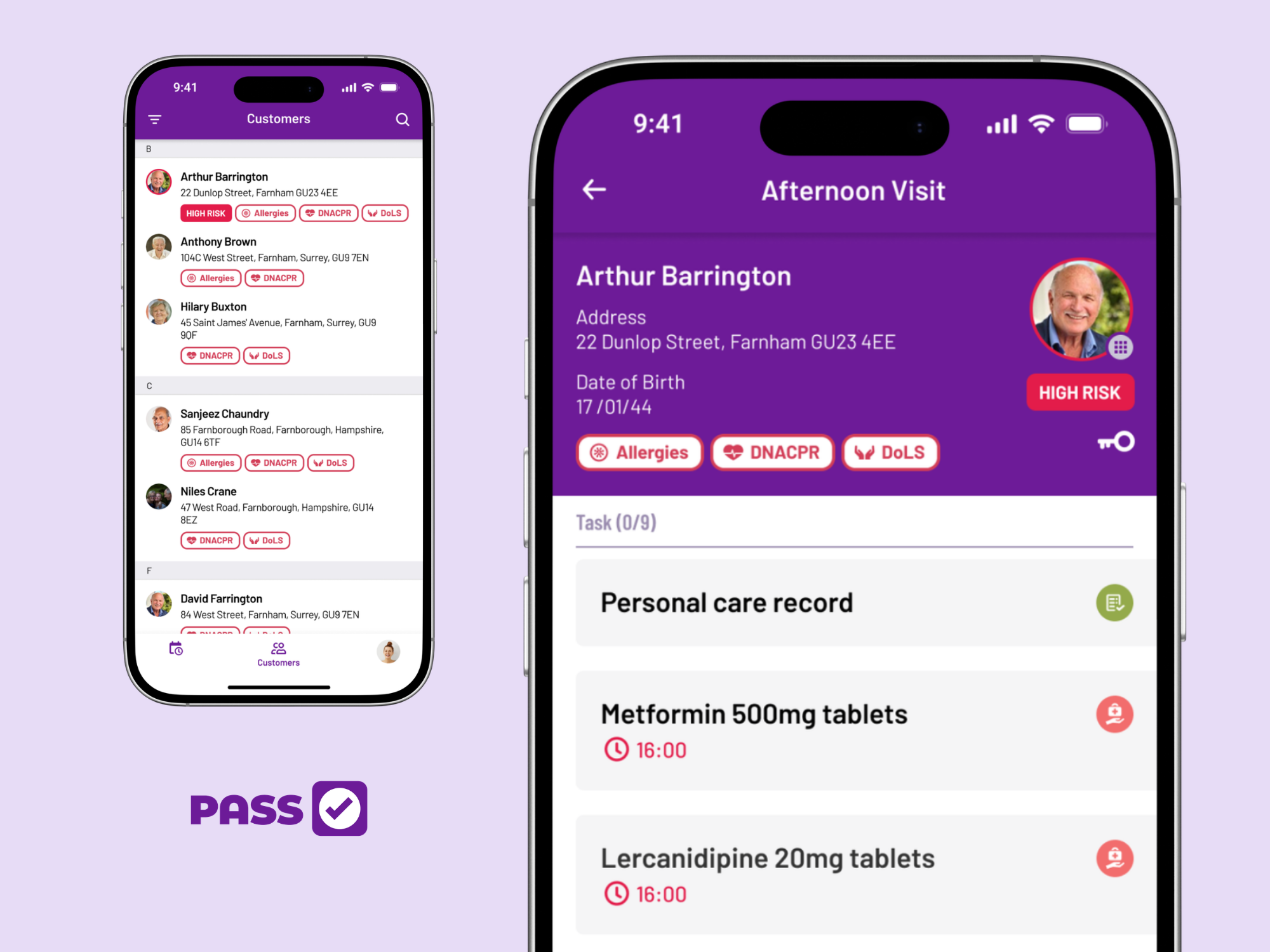
Every medication task listed for the visit in the PASS app, with allergies and risks up front – and each dose timestamped as it’s recorded
Here’s how that compares to a paper MAR chart:
The team at PASS will even provide training for your care workers, so they’re confident using the software. Combined with good medication administration training and regular comprehensive audits, PASS eMAR helps improve medication safety across your care service.
Book a free tour
Medication records without the gaps
PASS eMAR gives you legible, timestamped medication records and real-time alerts – so every dose is given, and every dose is recorded.
Book a 20-minute demo85,000+ care professionals · live in 30 days or less · 24/7 UK support