Your client has just come home from hospital, and his medication has changed. His usual carer has been away. How can you be certain she knows exactly what to give him?
The short answer
In this guide, we’ll look at what you should include in handover notes in a home care setting, identify some areas where your handovers might be going wrong, and look at how you can improve your processes for communicating changes to care staff.
2 minutes, no email needed
Six questions about how your service shares changes – on a busy day, not a perfect one. You’ll get a rating and the gaps to close first. Your answers stay on this page – nothing is saved or sent anywhere.
Does every change – medication, health, family concerns – get written down the same day?
Do your handover notes follow a set format, so nothing gets left out?
Do carers check the latest notes before every visit – even for clients they know well?
Would a medication change reach the next carer before their visit starts?
Can only authorised people see your handover notes?
Can you be certain a carer is reading the newest version of a care plan?
0
out of 12
Close these first

You need to make sure that you’re giving the next carer all the right information to support a client. All care handovers should include:
Here’s how that looks in practice:
Linda Smith, 12 Avenue Road
Visited by Sophie Jones · 28/09/2026 at 08:30
Health
Linda has a broken wrist after a fall on 26/09/2026. She also has high blood pressure and a dementia diagnosis.
Medication
Linda may take paracetamol and ibuprofen to manage pain – a change since 26/09/2026. Linda takes 5mg amlodipine at 09:00 every day.
During visit
Linda’s son was concerned that she was in pain. She took 500mg paracetamol at 08:35. She ate two slices of toast with jam, and drank one cup of tea. She took 5mg amlodipine at 09:00 after breakfast. She did not feel confident to shower alone after her fall, so I supported her to shower and dress. She took 200mg ibuprofen at 10:30. She was not in discomfort when I left.
Next carer
Linda may have her next paracetamol dose at 12:35 and her next ibuprofen at 14:30. She is expecting a call from the fracture clinic this afternoon between 12:00 and 16:00.
Your care service may already have a handover plan or template. Lots of health and care organisations, including the NHS, use a system called SBAR: Situation, Background, Assessment, Recommendation. It helps carers and other healthcare professionals include all of the appropriate details.
Situation
Identify the client, yourself, and any immediate areas of concern.
Background
Explain the client’s health concerns and relevant medical history, including any current medications.
Assessment
Describe what occurred during the visit.
Recommendation
Explain any follow-ups that need to happen during the next visit.
Book a free tour
Put every change in every carer’s pocket
PASS syncs care plans, daily notes and medication changes to the carer app in real time, so the next carer always knows what changed.
Book a 20-minute demoUsed by 1,250+ UK providers · 24/7 UK support
You might find that carers don’t know about medication changes, or other important information isn’t being communicated. Generally, it comes down to communication: either your carers aren’t sharing the important details, or they’re not picking them up when other team members pass them on.
This is more likely if:

There’s no getting around this one: it can be harder for home care services to keep up with handovers.
In a residential service, key dates and information might be posted around the care office, and carers pass through there regularly. When your staff spend all their time travelling to clients’ homes, you don’t always get this luxury.
If you’re a domiciliary care agency, make sure that your team know how to use your home care software, encourage them to write everything down, and remind them to check care plans and daily notes at every visit.
Carers assume that they’ll remember a conversation in the office, or that a client will remind them about allergies or medication changes. But this doesn’t always work.
In a well-organised service, everything is written down. Record changes in the client’s care plan, as well as their daily care notes, so that other carers will see them.
Lots of care teams use messaging apps for handovers. However, you could be putting your clients’ health and privacy at risk.
Messages get missed
In a fast-moving conversation, the one update that matters is easy to scroll past.
Anyone with the phone can read it
Depending on the app, its developers may be able to read your notes too.
Backups can leak
WhatsApp chats often back up to unencrypted cloud services, where others may have access.
WhatsApp isn’t GDPR-compliant, and, if you’re storing client data somewhere that unauthorised users can see it, you could open yourself up to safeguarding complaints.
of care organisations now use digital care records, according to the Department of Health and Social Care. Read the announcement
That still leaves up to one in five services working from paper. If yours is one of them, you’re at risk of missing key information in your care handovers. Physical paperwork can easily get lost – and you can’t always verify that you’re reading the latest version.
Whether you use messaging services, paper records, or care management software, there are often improvements you can make. Start from whichever describes your service today.
You need to improve your security and make sure that your team are reading every relevant message.
Use a secure app
Look for one that requires a PIN or biometric credentials to open any conversation, and check how it handles backups.
Pin a handover template
Create a template and pin it to the top of the chat.
One post per visit
Carers post their completed handover note when the visit is finished – nothing else.
React to confirm it’s been read
The next carer reacts to the handover post at the start of their visit, so you know they’ve seen it in time.
No casual chat
Keep the handover chat for handovers only.
If you’re using paper records, the best way to improve your handovers is to switch to care management software.
The PASS carer app gives your carers instant access to the latest care plans, MAR charts, daily notes, medical history, allergies and risk assessments. Everything that’s been recorded is on the carer’s phone – no need to worry if they’ve missed a WhatsApp message or an in-person meeting.
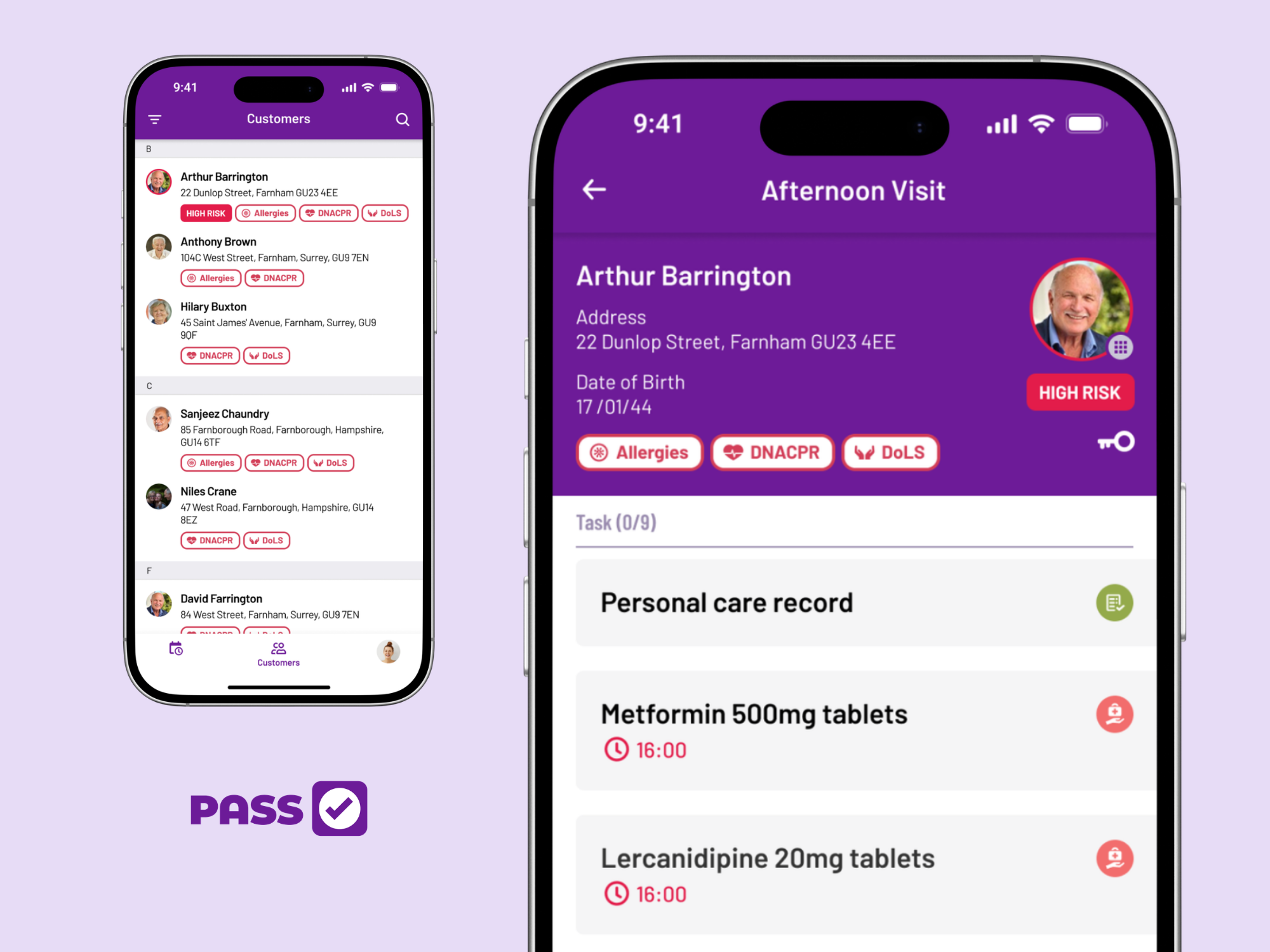
The PASS carer app shows each client’s visit tasks, medication and key risks before the visit starts – so the next carer always knows what changed
Here’s how that compares to a group chat or paper file:
It’s the easiest way to improve your care handovers and make sure that your team are communicating well.
If you’re already using care management software, you’re on the right track.
Check that your team are using it properly – make sure they’ve been trained, and understand exactly what to include in each handover note. Make software training part of your standard onboarding programme, hold regular refreshers, and audit your records regularly so you catch issues quickly.
Want to make sure that your team are getting handovers right? Share these eight habits with them.
01 · Be concise
Colleagues are probably reading on the go, and want the crucial details immediately.
02 · Lead with what matters
New medications, hospitalisations and changes to health and wellbeing always come first.
03 · Write it down now
Don’t tell yourself you’ll remember to pass it on later.
04 · Skip the jargon
Avoid unfamiliar abbreviations – other people may not understand them.
05 · Facts only
Don’t speculate or make judgements about clients and their health.
06 · Keep it confidential
In person, on paper or online, only the necessary people should see or hear it.
07 · Remember your audience
Notes may be read by managers, clients, families and CQC inspectors. Write accordingly.
08 · Ask questions
If a handover is missing details, ask the previous carer – and record the answer.
Book a free tour
Never let a change go unseen
Give your team one secure record of every visit, update and medication change – ready for the next carer, and ready for inspection.
Book a 20-minute demo85,000+ care professionals · live in 30 days or less · 24/7 UK support