It’s been a bad night. A client had a fall after her last care visit, and she wasn’t found until the next carer went round in the morning. The carer did everything right – now you need to do your part.
The short answer
Well-written incident reports cover you as an organisation, and your carers as individuals. They can also help you spot patterns in your client’s safety, behaviour, or health – and help you make changes to keep them safe.
In this guide, we’ll look at what an incident report should include. We’ll also share some incident report examples from domiciliary care, talk about what happens afterwards, and explain how you can write a good incident report with the help of care management software.
2 minutes, no email needed
Here are five lines from incident reports. Imagine each one being read out a year from now, by an inspector or a solicitor. Would it hold up – or need fixing first?
“Margaret seemed drunk and was being difficult, so I helped her to bed early.”
“David fell in the bathroom at 07:40. He hit his left elbow on the sink. I checked him, found a small graze, applied a plaster and stayed until he felt steady.”
“There was a problem with Tom’s medication this morning. All sorted now.”
“Grace tripped on the rug by her armchair but caught herself on the table. No injury. I moved the rug and asked the office to review her falls risk assessment.”
“I’ll write it up properly at the end of my shift – I remember it all clearly.”

Every incident report needs five things:
Key details
The date and time, location, and the people involved.
A full description of the incident
Stick to the facts, and describe everything in detail.
Any injuries or damage
A written description, plus a diagram or body map if necessary.
Actions taken
Administering first aid, calling paramedics, notifying a manager, calling relatives.
Lessons learnt and changes to make
You may need to review a client’s care plan or risk assessment, make changes to their home, or update your operational policies.
Incident reports should be completed as soon as possible, so that the incident is still fresh in your mind.
A badly-written report, or one that doesn’t include all the important details, can look like you’re trying to cover something up – even when that’s not your intention.
Vague descriptions
Writing “John fell” rather than explaining exactly what happened.
Missing witnesses
If there’s an investigation, you may need to contact the people who were present.
Writing it up too late
Leave it too long, and you might forget key facts.
No follow-up
Suggested actions aren’t completed, or changes aren’t recorded.
Some carers assume they don’t need to report anything if there was no injury. Others avoid it – they’re short on time, or afraid of getting in trouble.
However, it’s important to report all incidents, however small. Repeated reports can indicate changes in a client’s condition, or show a need to alter their care plan – helping to keep them safer in future.
Make sure your team feel safe to report incidents. Avoid unnecessary recriminations, or bringing up past incidents once they’re over and lessons have been learnt. Give team members time to write reports, show them examples from your own service, and make sure they’re trained to use your care planning software for incident reporting.
Your report should focus on facts, not opinions, unnecessary details or vague comments. Here are two examples, rewritten.
Before
Alex was messing about and being silly. He fell over a bench and started crying. I think his wrist hurt.
After
Alex was climbing over a bench in the park. He caught his foot on the back of the bench and fell to the ground, landing on his wrist. He cried out and grabbed his wrist with his other hand.
The first version judges Alex’s behaviour, and doesn’t explain why the carer thinks he was in pain.
Before
I was washing up in the kitchen after supporting Joseph into bed when I heard a loud thud. I ran upstairs and found Joseph lying on the floor by his bed. The TV was on, playing Match of the Day. He was wearing his favourite pyjamas – the legs are too long and he says he tripped over them.
After
I was in the kitchen and heard a thud from Joseph’s room. I found him lying on the floor by his bed. He explained that he tripped over the legs of his pyjama trousers as they are very long.
No judgement here, but plenty of detail that doesn’t relate to the incident.
Book a free tour
Every incident logged, followed up and signed off
PASS timestamps every incident report, links it to the client’s notes and care plan, and alerts your manager to review and sign it off.
Book a 20-minute demoUsed by 1,250+ UK providers · 24/7 UK support
Some incident reports warrant a safeguarding referral. An incident is usually treated as a safeguarding concern if it involves neglect, abuse, repeated poor practice, or unexplained injuries. Three examples:
Mary fell out of bed when she was alone. She was found by her carer 10 minutes later and suffered no serious harm.
Not safeguarding
Kira was found on the floor next to her sofa. She had bruises all over her body, in a way that didn’t seem consistent with the fall she described.
SafeguardingKira may have been a victim of physical abuse.
Alan can’t prepare food or wash independently. His son supports him at weekends, and the home care agency during the week. On Monday he mentions that his son didn’t visit over the weekend.
SafeguardingAlan may have been a victim of neglect.
If you have a concern, contact your local authority’s adult social care team to make a safeguarding referral, and follow your organisation’s policy on logging the issue.
In an emergency, call 999
Report the incident to the police straight away.
Some incidents also need to be reported to the CQC or the HSE under RIDDOR:
Incident
Who to tell
CQC + HSE
Serious injury to a service user caused by care activities or the environment. Tell the HSE too if it happened as a result of care provision and the client went to hospital.
CQC
Allegations or suspicions of abuse.
CQC
Death of a service user during, or as a result of, care provision.
HSE
A staff member off work for more than seven days.
HSE
Faulty equipment or an unsafe working environment.
HSE
Gas leaks or fire.
Making the incident report isn’t the end. The incident is an opportunity for your care service to learn, so that you’re constantly improving client safety.
At minimum, you’ll need to investigate the cause and review risk assessments. You may need to make a safeguarding referral, apologise to the client and their family, or change your organisational policies and procedures.
The carer, straight away
The manager, afterwards
The best way is to use care management software, so that every record includes a timestamp and is linked to a client’s notes and care plan.
PASS lets you create an incident report in just a few steps. Every report is timestamped and linked to the client’s notes, and follow-ups and lessons learnt are saved in the same report – so auditing is easy. Need your own incident report template? PASS lets you build one.
Open the customer
View your list of Customers, and select the customer involved in the incident.
Go to Documents
On the mobile app, tap Menu, then Documents. In a desktop browser, choose Documents.
Add an incident
Select Incidents, then choose Add document.
Complete and save
Fill in the report, then click Save.
Your manager signs it off
PASS automatically informs your care manager, who reviews the form, adds notes and lessons learnt, and signs it off.
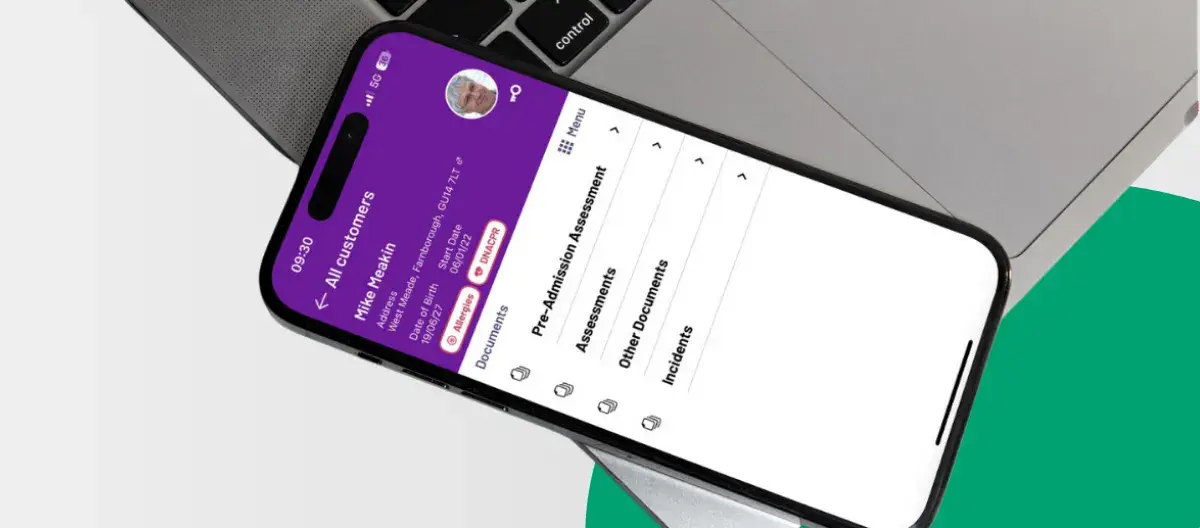
Incident reports live in each client’s Documents area in PASS – timestamped, linked to their notes, and flagged to your manager to sign off
Find out more about how PASS helps you write incident reports that stand up to scrutiny
PASS home care software includes templates for incident reporting, but it helps to see a good report in full. Here’s a sample you can use as a guide.
Julie Green · Fall
15/10/2026 at 14:30
Location
Julie’s kitchen, by the chair and table
Safeguarding
No
Completed by
Sarah Williams, care team lead – present in the home at the time of the incident
What happened
Julie was walking in the kitchen with her stick. She caught the stick on the leg of the chair and tripped. She landed on the floor and complained of pain in her right knee (diagram included). She was unable to bear weight on her knee after the fall.
Injuries
Dislocated right knee
Actions taken
Sarah conducted standard post-fall checks – Julie was unable to bear weight on the injured knee. Paramedics called. Care manager notified. Julie’s daughter notified. Paramedics took Julie to hospital.
Changes made
The environment wasn’t safe – the chair hadn’t been pushed under the table, causing a trip hazard. Sarah moved the table and chair to the side of the room, so there’s space for Julie to walk through in future.
Future changes
Julie’s care plan will need to be reviewed at hospital discharge.
Others involved
Aaron Smith (paramedic called to the scene), Ellie Cole (care manager, notified), Amy Green (Julie’s daughter, notified)
Book a free tour
Turn incidents into safer care
Report in the moment, track patterns across your service, and show inspectors a complete audit trail – all in one place.
Book a 20-minute demo85,000+ care professionals · live in 30 days or less · 24/7 UK support